
Benefits of Universal Design

Universal Design, also known as Inclusive Design, is a proactive approach to creating electronic materials that benefits all – faculty, staff, and students. With Universal Design, we focus on eliminating the barriers in the environment so that fewer accommodations are needed. It streamlines content editing, makes materials more usable for everyone, and reduces the need for last-minute accommodations for students with disabilities.

The following image demonstrates how the environment is the barrier to being able to reach the whiteboard, not the person. It shows how designing our environment in a way that naturally includes people with disabilities reduces the need for accommodations.

Note that in the accessible example the person is still using the walker, so some accommodation is still needed. However, the environment meets their needs and no extra retrofitting is required. In an electronic example, the person would still need to use assistive technology to read a PDF, but the PDF would be readable without modification.
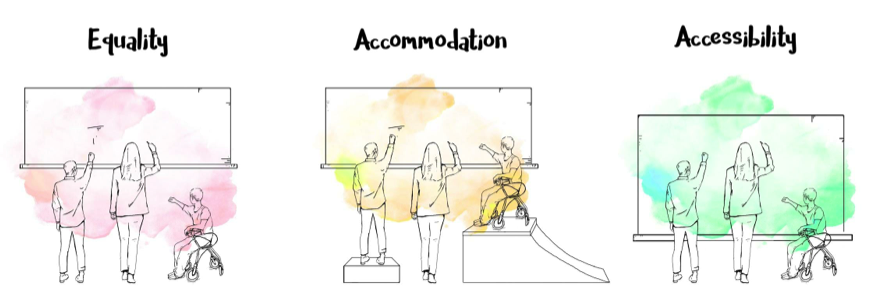
Whiteboard illustration showing the difference between equality, accommodation and accessibility
Image Description: Three pictures show the difference between equality, accommodation, and accessibility. Each has a white board with three people in front of it: one shorter, one taller, and one that is seated on a 4-wheeled walker. In the first picture showing equality, only the tallest person can easily write on the board. In the second picture showing accommodation, the shorter person is standing on a block, and the person sitting on the walker is raised up on a block with a ramp. Now everyone can write on the whiteboard. The last picture showing accessibility has a larger whiteboard that is also set lower on the wall. Everyone can reach it easily without needing a block or a ramp. (Image used with permission from: https://otis.libguides.com/accessibility)

When we design electronic materials to be accessible as part of our process instead of fixing problems after the fact,

  • We establish a baseline of access for the community.
  • Accessibility becomes part of the workflow.
  • Less retrofitting is needed.
  • Timeliness is significantly improved.
  • Benefits also extend to people without disabilities.

Benefits to Individuals with Disabilities

There are considerable benefits both to the individual and the community when we follow a universal design approach:

  • Individuals can access electronic content independently with their assistive technology, without having to request help.
  • Timeliness: because materials are already accessible, assistive technology users can access them at the same time as others.
  • Those who don’t want to identify formally as having a disability also benefit.

Benefits to the Community

  • The responsibility for making our community inclusive is more evenly distributed.
  • Disability support offices can focus on complex cases where additional accommodations are still necessary.
  • Faculty and staff don’t have to rush to fix content on demand.
  • Everyone in the community can use materials in a way that works best for them. Universally designed materials are flexible to use with a variety of technologies.

The following video shows students (both with and without disabilities) talking about the different ways they access their readings and how universally designed content benefits them.

Drawbacks of the Accommodation-Centered Approach

Disability accommodations are modifications or adjustments that enable individuals with disabilities to participate equally. Accommodations can and may need to be adjusted and customized to each unique environment, course, or situation.

There are considerable burdens both on the individual and on the community when we follow an accommodation-centered approach.

Impact on Individuals with Disabilities

  • The individual has to seek help and wait for that help to materialize.
  • Retrofitting content takes time. Students may lose time to work on assignments, fall behind in classes, and even have to drop out.
  • Individuals have to formally identify as having a disability to receive accommodations.

Impact on Faculty and Staff

  • Faculty and staff have to retrofit their content at the last minute. This leads to unexpected stress for the instructor who did not anticipate having a student with a particular need in their course. Timeliness can become a huge problem, depending on the volume of materials.
  • Faculty and staff may need additional training to provide the accommodation, which also affects timeliness.
  • Disability support offices carry the majority of the burden for ensuring accommodations are followed. With electronic accessibility, this task is impossible for just a few people to handle in a timely fashion.